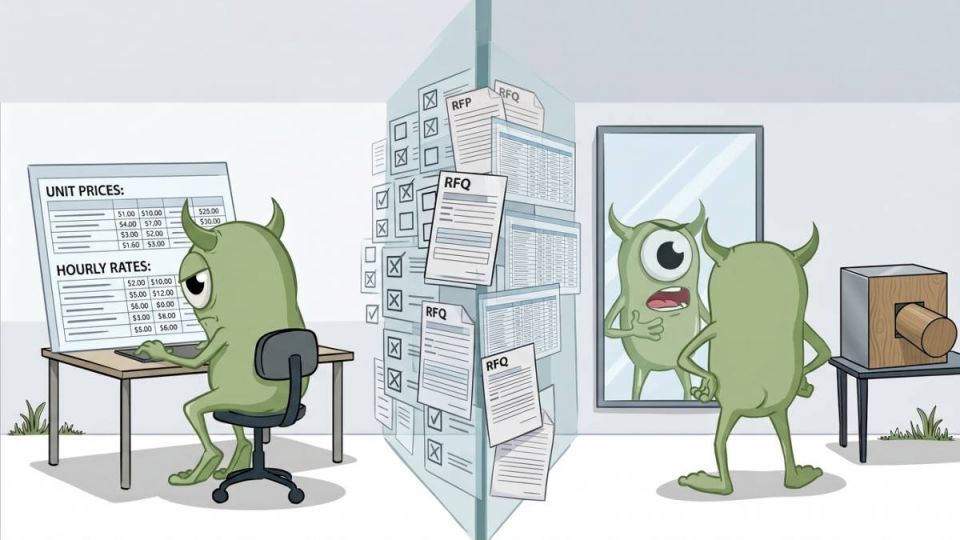
Many professional firms begin new client engagements with some form of discovery session. However, most of the time these conversations are very formulaic, aimed at checking boxes, asking Boolean questions, and filling out a spreadsheet. Rarely among professional firms there is an enforced requirement to ask open-ended, curiosity-driven questions or engage the client in exploration of potential contradictions and misalignment of their current goals or objectives.
Turns out that primary among many reasons for such a procedural preference is the dopamine kick both professionals and management get from pursuing well-defined, familiar problems, proving one’s worth to themselves and to the prospect. (I don’t know about you, but I have occasionally caught myself fantasizing about an on-the-spot delivery of a witty, absolutely brilliant professional advice — folks around me applauding with awe and all.) That’s a temptation many knowledge workers have to contend with.
It takes little effort to withdraw from the institutional or professional memory banks the standard solution to what appears to be a standard job, and provide the correct answer on the spot — looking and feeling smart. While on the other hand it takes much effort and a good deal more courage to slow down, challenge the client, thus inevitably delaying the immediate gratification offered by checkboxes and a sense of progress.
Not to mention the reluctance of asking seemingly foolish, awkward questions, thus opening oneself up to being labeled incompetent — the major fear most professionals are petrified by. The fear that lives rent free in their heads, because most clients have no means of discerning between “stupid” and ingenious questions.
Because it feels efficient and rewarding, professional firms often default to what Daniel Kahneman would call System 1 behavior in discovery: quick categorization, canned questions, and immediate solutions. The real discovery, however, requires System 2: slowing down, tolerating uncertainty, and thinking before jumping to conclusions. This is, of course, quite taxing.
The "Vendorification" Trap in Professional Services
The incentive systems in place aren’t supportive either. Those are often set up in a manner disproportionately skewed in favor of short-term results. Very little is made to reward professionals for engaging clients in activities that challenge their direction and goals. Put differently, the incentives management puts in place work against strategic, long-term perspective and in favor of quick closing techniques. The systems reward sales, not exploration.
The buyers are neither simpletons nor strangers to such a convenient preference on the vendors’ part. Naturally, procurement has caught onto this long ago. When most service providers act similarly, — rushing an oddly shaped client to take the shape of a rectangular peg that fits the solution’s square hole — it’s safe to assume that the vendors are more alike in their proclivity for self-interest than they are different. Hence, the ongoing “vendorification”.
A vendor is an abstract category devoid of meaning and nuance. Of course, any service provider who is unfortunate to fall into that category will be compared not on its unique capabilities, competencies, point of view, principles and values, but on arbitrary, primarily quantitative (rarely qualitative) criteria such as price, speed, scope, feature-fit, bench size, et cetera. That is a rational behavior on the buyer’s part. However, such preference completely fails to recognize the intangible nature of services; the fact that it is the human beings, not machines, that will perform rather than simply execute the bulk of the work.
The irony is that firms often contribute to their own commoditization. Seeing service providers choose to copy one another en masse, turning somersaults into the wall of sameness with a lung-shattering battle cry for increased efficiency, standardization, simplification, unification, and homogeneity, it’s fair to assume witnessing the march of mindless clones. One thing that’s terrific about the clones is that they are exceptionally interchangeable.
Why Standard RFPs Create a Losing Game for Buyers and Sellers
Since the professional firm isn’t interested in going first by helping us — the buyer — understand what we don’t know, to change our perspective if necessary, naturally, we have no particular interest in educating them either. There’s just no evidence that they’d care to listen. Besides, buying professional services is emotionally loaded for us. We feel insecure, exposed, skeptical, and suspicious.
Consequently, buyers default to launching RFP cattle calls, coercing participants to conform. And so we end up with a classic Prisoner’s Dilemma. Each side behaves rationally, following their own best interests, yet in a way that makes both worse off.
On the one hand, the buyer is cautious about overpaying for generic performance. They have no means of discerning the technical quality of superb versus competent work, yet they need to prove to themselves and internal stakeholders that they have “vetted” the market. Often in an attempt to generate enough “column fodder”, buyers naturally employ quantitative universals such as hourly rates, staffing structure, unit prices, and so on. It is much easier this way to compare vendors, create a convincing illusion of a “fair market value” and then make a rational, justifiable decision. In addition, the internal rewards and incentives entice procurement to “squeeze” vendors. Certainly, the fear of getting in trouble for hiring the “wrong” provider is a contributing factor as well.
On the other hand, service providers have KPIs of their own. Having participated in many RFPs, professional firms are convinced that getting hired is a numbers game. Folks responsible for business development and sales have quantitative targets to adhere to. Their rewards and incentives aren’t supportive of taking the time to establish relationships. The typical service provider seeking efficiency is reluctant to “waste time” on window shoppers and bargain hunters.
As a result, the highest perceived payoff for each side is a retreat to checklists, standardized RFP process, and formulaic discovery — the path of least effort and lowest costs. Because both parties refuse to cooperate, both lose in the long run.
There are two reasons why the prisoners in the original dilemma fail to collaborate. First, the system doesn’t allow them to communicate with one another. Second, both prisoners are self-interested. Similar to solving the Prisoner’s dilemma, the only way out of this losing game is to go first; in the right direction.
Overcoming Adversarial Relationships in Business Development
Instead of cooperation, the typical managerial response, however, is (among other things) to do more sales training. To beat procurement at their own game, as they say, ignoring the fact that procurement is constantly learning how to counter these new techniques, coming up with clever moves of their own.
Unfortunately, the default solution is to hire the next sales guru who will teach professionals the latest magic words that will definitely — this time unmistakably — place a potent Confundus charm on the toughest of procurement specialists.
Most of such training is a complete waste of time and resources (as well as gray matter, for that matter) because it fails to address the underlying issue: to understand selling, one must understand how people buy. Notice as well that an espoused sales approach is typically adversarial: us versus them. We must outsmart, outcompete, outmaneuver, overpower the enemy which is automatically anyone in the procurement role. And rarely the realized message is about cooperation with an honest intent to find a win-win scenario. Well, guess what — if sales seek to overpower procurement, they logically seek to overpower the seller. The Empire always strikes back.
Anyone who’s ever been on the buying side knows how cringy and superficial some of these freshly indoctrinated salespeople sound. They memorize the steps and stages along with the latest spells, and, zealously chanting in a blind rush, push and shove the prospect through a conveyor belt of staged sales conversations toward closing. Again, they rush for the money.
The firm’s partners (and everyone in sales roles) are adamant, “If there is no stream to carry the ship, our crew will row. If there is no wind, the crew will blow into the sails. If there is a storm, we’ll sacrifice the worthiest to Poseidon. Dear Client, we’ll get you the results no matter what!” When you are the buyer, doesn’t it sound too good to be true? Doesn’t it scream neediness? Or delusion? Or worse? Aren’t your spidey senses already tingling?
It is no wonder that so many buyers ghost vendors after discovery conversations. Naturally, it is psychologically comforting for professionals to then put the blame on them, the buyer (never us), and begin chasing another exciting prospect. Because that’s always more fun. Instead, management ought to look in the mirror and analyze the firm’s behaviors toward prospects and clients.
What often occurs during courting and sales conversations is that the business development and sales folks spend roughly 80% of the time talking about the firm: our achievements, our rankings, our awards, our previous successes, our market share, and all the other wonderful things about us. So much so that they forget about the needs of their counterparts. They seek to dazzle prospects rendering them speechless.
Self-oriented bragging inescapably gets in the way of listening to what the prospects have to say. If you’re on a 30-minute sales call, and you keep on boasting for 24 minutes straight, there aren’t that many opportunities to listen in the remaining six minutes. And when you don’t ask questions about their world, and you don’t actively listen, how would you learn about their true aims and goals? Again, most clients are not in a position to formulate those accurately without professional assistance.
How to Break the Cycle: The Power of Going First
Clearly, the reverse should be the norm. What’s more, the listening itself should never feel as if the professional is trying to get it over with ASAP, to check another box against the listening/talking (80/20) requirement. With a stopwatch. What must unfold during client-centric discovery sessions is the actual discovery of new facts, perspectives, plans, expectations, broader context, and meaning.
Professionals must learn to get curious and genuinely interested in asking questions that lead to understanding clients’ worldview, their challenges and aspirations given the current context. Clients and prospects ghost professional firms because we are exceptionally successful at proving that we care about us, not them.
When there is no reciprocity in the long-term game, every party is doomed to remain an eternal prisoner of their own doing. Because this article was written not for the buyers of professional services but for the service providers, my message is to you, dear Professional: You should go first.
The awezzom question of the day:
What are we doing to facilitate win-win scenarios?
P.S. I’m in the process of writing a book on the topic of service offering positioning. In it, I will explore many topics such as this one. If you’ve found this article useful and not too boring, consider signing up to receive my emails. You will be among the first to know when the book is out. Thanks.